10 Reasons Your Duramax DPF Code Isn’t Actually a Clogged Filter
Seeing a “Clean Exhaust Filter” or “Reduced Engine Power” message on your dashboard is enough to make any Duramax owner’s heart sink. For many, the immediate assumption is that the Diesel Particulate Filter (DPF) is completely plugged and needs an expensive replacement. In reality, the DPF is often the victim of a problem occurring elsewhere in the engine or exhaust system.
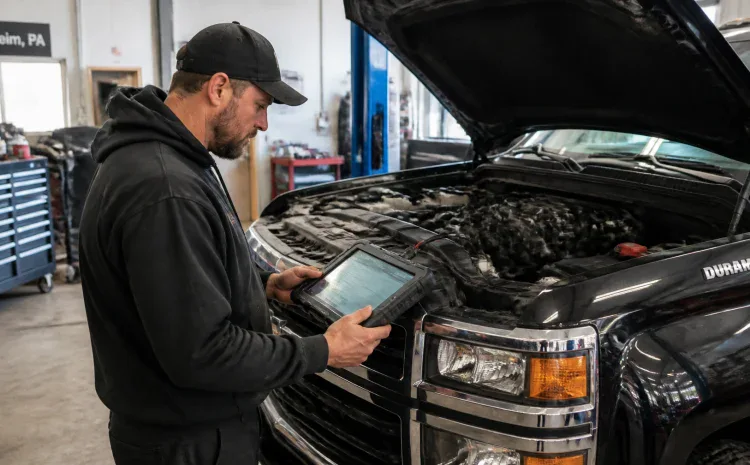
At Durastroke Mechanical, we see many diesel pickup truck owners in the Manheim, PA area who have been told they need a new DPF when they actually just need a specialized diesel diagnostic. The DPF system is complex, and the computer relies on a web of sensors to determine if the filter is working. If even one of those sensors provides bad data, the computer triggers a code that looks like a clogged filter.
Before you commit to a multi-thousand-dollar repair, it is essential to understand that a DPF code is often just a symptom, not the root cause. Here are 10 common reasons your Duramax is throwing DPF codes that have nothing to do with a physically blocked filter.
1. DPF Differential Pressure Sensor Malfunction
The most common “fake” DPF clog is caused by the differential pressure sensor. This sensor measures the pressure before and after the DPF to determine how much soot has accumulated. If the sensor fails or begins to “drift” (providing slightly inaccurate readings), it might tell the ECU that the pressure drop is too high.
The computer interprets this as a clogged filter and triggers a P2463 or P2002 code. During a proper diesel diagnostic, a technician should check the live data of this sensor at idle. If the pressure is high while the truck is just sitting there, the sensor is likely the culprit, not the filter.
2. Cracked or Clogged Pressure Sensor Hoses
The differential pressure sensor doesn’t sit directly in the exhaust stream. Instead, it is connected to the exhaust pipe by small rubber or metal hoses. Over time, these hoses can become brittle, crack, or melt. They can also become plugged with soot or frozen condensation.
If a hose is cracked, it leaks pressure, causing the sensor to receive a signal that doesn’t make sense to the ECU. If the hoses are clogged, the sensor might see a “permanent” high-pressure reading. Checking these hoses is a simple step that can save you from a massive repair bill for a Duramax repair in Manheim.
3. Exhaust Gas Temperature (EGT) Sensor Faults
Your Duramax uses several EGT sensors to monitor the heat required for a successful “regeneration” (the process of burning off the soot in the DPF). If an EGT sensor is reading too low, the computer may believe the exhaust isn’t hot enough to clean the filter.
If it reads too high, the computer might abort the regeneration process to prevent damage. In either case, the soot continues to build up, or the computer triggers a fault code because the expected temperature changes aren’t occurring. Replacing a $150 sensor is a much better outcome than replacing the entire DPF.
4. Exhaust Leaks Before the DPF
Any leak in the exhaust system between the turbocharger and the DPF inlet can cause major issues. A leak allows exhaust gases: and pressure: to escape before they ever reach the filter. This skews the data that the differential pressure sensor is trying to read.
When the ECU sees a discrepancy between what the mass airflow sensor says is going into the engine and what the pressure sensor says is in the exhaust, it often defaults to a DPF efficiency code. We often find loose clamps or cracked flex pipes are the real reason for these “clogged” codes.

5. Faulty Diesel Exhaust Fluid (DEF) Injector
While the DEF system and the DPF are separate components of the emissions suite, they work in tandem. If the DEF injector is leaking or “crystallized” with dried fluid, it can disrupt the chemical reactions in the Selective Catalytic Reduction (SCR) catalyst.
While this often triggers DEF-specific codes, it can sometimes interfere with the overall emissions logic, leading to “Reduced Engine Power” modes that feel identical to a DPF failure. Keeping the DEF system healthy is vital for diesel pickups and engine repairs of all sizes.
6. Upstream Fuel Injector Issues
If your Duramax has a fuel injector that is “hanging open” or has a poor spray pattern, it will produce excessive amounts of soot. This is often called “running rich.” The DPF is designed to handle a certain amount of soot, but a failing injector can overwhelm the system faster than it can regenerate.
In this scenario, the DPF is becoming clogged, but the DPF isn’t the problem. If you simply replace the DPF without fixing the faulty injector, the new filter will clog in just a few hundred miles. Professional shops in Manheim, PA look for these “upstream” causes to ensure a permanent fix.
7. EGR Valve and Cooler Problems
The Exhaust Gas Recirculation (EGR) system is responsible for lowering combustion temperatures to reduce NOx emissions. If the EGR valve gets stuck or the cooler becomes plugged, it can drastically increase the amount of particulate matter (soot) leaving the engine.
Much like the injector issue, an EGR fault will cause the DPF to fill up prematurely. Many DPF codes are actually caused by a carbon-caked EGR valve that is no longer regulating the flow of exhaust back into the intake correctly.
8. Turbocharger or Boost Leaks
For a diesel engine to burn fuel cleanly, it needs a specific amount of air. If you have a boost leak: perhaps in a silicone boot or the intercooler: the engine isn’t getting the air it needs. This results in an “air-starved” combustion process that creates heavy black smoke.
Even if you don’t see the smoke out of the tailpipe (because the DPF is catching it), that soot is rapidly filling the filter. A DPF code is often the first sign that your turbocharger isn’t producing the required boost or that you have a simple leak in a charge air pipe.
9. Short Commutes and Incomplete Regens
Modern Duramax engines need to reach a specific operating temperature and maintain a steady speed for about 20–30 minutes to complete a “Regeneration” cycle. If your daily drive is only five or ten minutes through Manheim, the truck may never get the chance to clean itself.
Over time, these interrupted cycles lead to a “soft” clog. The filter isn’t broken or at the end of its life; it just needs a “forced regeneration” using a professional scan tool. This is a common maintenance task we perform for drivers who use their diesel trucks for short trips.
10. Damaged or Corroded Wiring Harnesses
The underside of a truck is a harsh environment. Salt, mud, and road debris can wreak havoc on the wiring harnesses that connect your sensors to the ECU. A single corroded pin in a connector or a wire that has rubbed through against the frame can cause intermittent sensor signals.
These “ghost” signals often trigger DPF codes because the ECU receives data that is physically impossible. Identifying a wiring fault requires patience and experience, but it is far less expensive than replacing heavy exhaust components.
Trust the Diesel Experts in Manheim, PA
At Durastroke Mechanical, we don’t believe in “parts cannon” repairs. We know that a DPF code can be frustrating, especially when your truck goes into limp mode. Our team uses advanced diagnostic tools and years of hands-on experience with Duramax, Powerstroke, and Cummins engines to find the true source of the problem.
Whether you need general maintenance to keep your rig reliable or a major engine rebuild to restore its strength, we are here to provide honest, straightforward service. We work on everything from family pickups to tractors and heavy-duty fleet trucks.
If your Duramax is acting up or showing an emissions warning, don’t guess: get a professional opinion. Stop by our shop in Manheim or contact us today to schedule your diagnostic. We’ll get you back on the road with a truck that runs as it should.
Ready to get your diesel truck running right? Contact Durastroke Mechanical today for expert diagnostics and repair.