Diesel Diagnostics Secrets: Why Your Local Shop Might Be Guessing
We’ve all been there. You’re driving down Route 72 near Manheim, your diesel truck is running just fine, and suddenly: ding: the check engine light pops up on the dash. Your heart sinks a little. You pull into the nearest general repair shop, and the guy behind the counter pulls out a little orange handheld tool. He plugs it in, reads a code, and says, “Looks like an EGR valve. We should probably swap that out.”
A few hundred dollars and two days later, you pick up your truck. You don’t even make it past the Manheim Auto Auction before that light is right back on.
This is the “Guessing Game,” and for diesel owners, it’s an incredibly expensive way to maintain a vehicle. At Durastroke Mechanical, we see it every single week. Customers come to us frustrated because they’ve already spent thousands of dollars at other shops, yet their Powerstroke, Cummins, or Duramax still isn’t running right.
The secret to why this happens isn’t a mystery: it’s the difference between a generic code reader and professional-grade diesel diagnostics.
The Code Reader Trap: Why a “Code” Isn’t a Diagnosis
There is a massive misconception in the automotive world that a diagnostic trouble code (DTC) tells a mechanic exactly what is wrong. It doesn’t. A code is simply a starting point; it tells the technician that a specific sensor is reading data outside of its normal operating parameters.
Most local general-purpose shops use “global” or generic OBD-II scanners. These tools are great for a Honda Civic with a loose gas cap, but they are woefully inadequate for a modern diesel engine. A generic scanner can tell you that there is a fault in the fuel system, but it cannot tell you why.
For example, if your truck throws a P0087 code (Fuel Rail Pressure Too Low), a generic shop might immediately tell you that you need a new CP4 pump or a full set of injectors. But that code could also be caused by a clogged fuel filter, a pinhole leak in a fuel line, or even a failing lift pump. Without the ability to run specific commanded tests, the shop is essentially blindfolded, reaching for the most expensive part first.
If you’re wondering why your dashboard looks like a Christmas tree, you might find our guide on 10 reasons your diesel check engine light isn’t going away helpful for understanding the basics before the “guessing” begins.
The “Parts Cannon”: An Expensive Way to Fix a Truck
In the diesel world, we call this the “Parts Cannon.” It’s a diagnostic strategy where a shop simply replaces parts until the problem goes away.
- “Code says EGR? Fire the EGR valve cannon!”
- “Light still on? Fire the EGR cooler cannon!”
- “Still on? Maybe it’s the sensors.”
By the time they find the actual issue: perhaps a simple wiring harness rub or a vacuum leak: you’ve paid for four parts you didn’t need. This happens because most shops lack the specialized software to talk to your truck’s individual modules.
A high-pressure fuel system issue on a 6.7L Cummins or a 6.6L Duramax can cost upwards of $10,000 if misdiagnosed. We’ve seen owners in the Manheim area spend nearly that much on “experimental” repairs at general shops before bringing the truck to us for a proper $150 diagnostic that finds the real $200 problem. You can read more about avoiding these 7 mistakes with your diesel fuel system to keep your wallet a bit heavier.

Dealer-Level Tools vs. The $50 Scanner
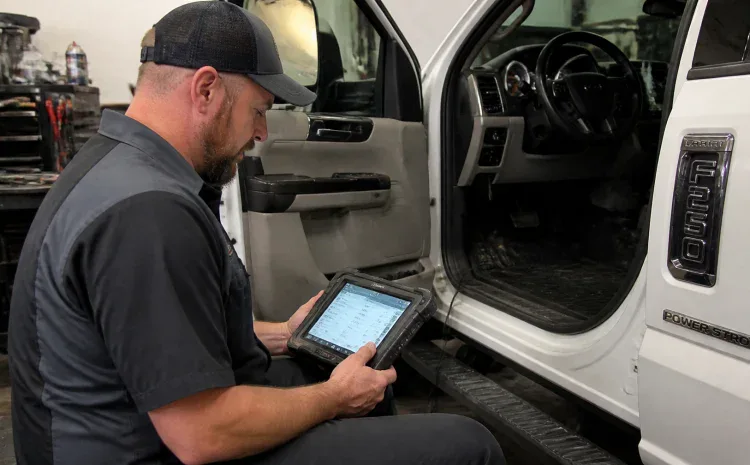
At Durastroke Mechanical, we don’t guess. We use the same level of diagnostic equipment you’d find at a dealership, often with even more specialized diesel-specific data. We utilize Ford IDS/FDRS for Powerstrokes, GM GDS2 for Duramax engines, and Cummins Insite for everything from pickups to heavy equipment.
Here is what these tools allow us to do that your local “all-makes” shop probably can’t:
1. Bi-Directional Controls
This is the biggest “secret” in diesel diagnostics. A generic scanner only reads data. Our tools can talk back to the truck. We can command the turbo vanes to sweep to see if they are sticking. We can command the fuel pump to ramp up pressure while the engine is off to check for leaks. We can turn off individual fuel injectors one by one to see which cylinder is contributing to a rough idle.
2. Relative Compression Tests
Back in the day, if you wanted to check engine compression, you had to pull glow plugs or injectors and spend hours with a physical gauge. With our professional diagnostic software, we can perform a relative compression test using the starter motor’s electrical draw and crankshaft speed. In five minutes, we can tell you if your Powerstroke has a dead cylinder without turning a single wrench.
3. Forced Regeneration and DPF Analysis
Emission systems are the #1 cause of downtime for diesel owners in Pennsylvania. If your DPF (Diesel Particulate Filter) is clogged, a generic shop will tell you to replace it. However, the clog is often just a symptom of a larger issue, like a leaking turbo boot or a faulty EGT sensor.
Our tools allow us to see the exact gram-count of soot in the filter and run a “Service Regeneration” while the truck is parked in our shop. This allows us to monitor the temperatures and pressures in real-time to find out why the filter clogged in the first place. For Duramax owners specifically, we’ve found that 10 reasons your DPF code isn’t actually a clogged filter can save a lot of unnecessary replacement costs.
Expertise Across the “Big Three” (And Beyond)
Every diesel engine has its own “secrets” and common failure points that require specific diagnostic paths.
- Powerstroke (Ford): Whether it’s an older 6.0L with FICM (Fuel Injection Control Module) issues or a modern 6.7L with high-pressure fuel concerns, Ford’s IDS system provides data that generic scanners simply can’t see. We can look at “Uncommanded Injector Events” and complex timing data that is essential for these engines.
- Cummins (Ram/Case/Fleet): Using Cummins Insite, we can access the heart of the engine’s computer. We can see “Duty Cycle” data that tells us how the truck has been driven, which is invaluable for diagnosing intermittent performance issues for our agricultural customers in Lancaster County.
- Duramax (GM): GM’s GDS2 system allows us to look at “Balance Rates” for the injectors. If one injector is dumping too much fuel or not enough, we can see it on a graph in real-time, preventing a melted piston before it happens.
Localized Care for Manheim Diesel Owners
We aren’t a massive corporate chain. We are your neighbors here in Manheim, PA. We know that many of our customers are using their trucks for work: towing trailers through the hills of Central PA or hauling equipment to jobsites in nearby Lancaster and Lititz.
When your truck is down, your livelihood might be on the line. That’s why we invest tens of thousands of dollars into diagnostic software and training. We want to get you back on the road quickly, and more importantly, we want to make sure the fix is right the first time.
If you are considering a major repair because a shop gave you a vague “we think it’s this” answer, stop. Before you commit to a full engine overhaul, check out our advice on how to avoid the biggest diesel engine rebuild pitfalls. A proper diagnostic might just save you from an unnecessary rebuild.
Conclusion: Stop Guessing and Start Testing
Diesel engines are complex, precision-engineered machines. They require more than just a “code pull” to be repaired correctly. If your current shop is suggesting expensive parts without being able to show you the live data or commanded tests that prove those parts are bad, they are guessing with your money.
At Durastroke Mechanical, we take pride in our straightforward approach. We show you the data, explain the “why” behind the “what,” and use the most advanced tools available to ensure your Powerstroke, Cummins, or Duramax stays reliable.
Don’t let the “Parts Cannon” drain your bank account. If you’re in Manheim, PA, or the surrounding area and your diesel isn’t running right, bring it to the experts who have the tools to see what’s really going on under the hood. Contact us today to schedule a professional diagnostic and get the answers you actually need.